In my “Trading with Pariahs” research with Keith A. Preble, East Carolina University, we explore the impacts of economic sanctions on states’ trading and illicit networks using social network analysis to better understand why some sanctions regimes are more effective at meeting their goals than others.
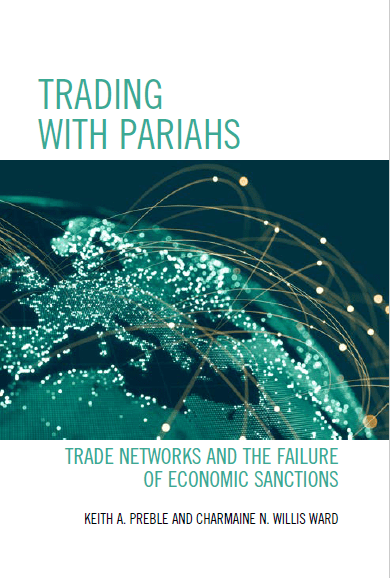
Trading with Pariahs: Trade Networks and the Failure of Economic Sanctions
The past few decades have witnessed a proliferation of economic sanctions, yet there seem to be few examples of sanctions meeting sender states’ goals. Under what conditions do sanctions fail to change the behavior of so-called international “pariah states,” countries who violate various international norms? This book examines the impact of economic sanctions on target states’ trading relationships through social network analysis, a method that has rarely been applied to the study of sanctions. Drawing on UN Comtrade data, the authors show that the imposition of sanctions can drastically change some states’ trading networks, as states either find new trading partners (in the case of North Korea) or feel the sting of the sanctions from key trading partners (like Iran). Others’ trading networks (such as Myanmar’s) remain relatively stable over time as key trading partners refuse to impose sanctions. Through the theory of weaponized interdependence, the authors argue that the success or failure of sanctions to change target states’ behavior depends on who imposes the sanctions. Sanctions imposed by the “right” sender states can be successful but also cannot rely solely on policies of isolation to achieve sanctions’ goals.
“Trading with Pariahs: North Korean Sanctions and the Challenge of Weaponized Interdependence“
Global Studies Quarterly
Why has North Korea avoided capitulating to economic sanctions pressures? We argue that economic sanctions have been ineffective and unsuccessful for three reasons: North Korea’s adeptness at evasion, other states’ unwillingness to enforce economic sanctions, and North Korea’s efforts to avoid panopticon effects via its diplomatic statecraft and policies that allow states to monitor and collect information on others. We contend that the implementation and enforcement of economic sanctions led North Korea to alter its trading network, reallocating trade to countries (or nodes) within its network willing to ignore international sanctions. As a result, these network shifts limited the ability of senders to weaponize the interdependence between them and North Korea effectively. We further highlight how North Korea conducts diplomatic statecraft in such a way that limits the impact of sanctions enforcing states from effectively monitoring it and limiting the impact of panopticon effects senders generate. To test our theory, we employ an ordinary least squares regression followed by social network analysis to understand how North Korea’s network of trade has adapted over time in the face of punishing economic sanctions. We find that states with greater diplomatic engagement enjoy better centrality than sanctions enforcing states. Also, economic sanctions at critical junctures induce changes to North Korea’s network over time with commercial imperatives to trade replaced by a North Korean near reliance on China. We further demonstrate that economic sanctions likely induce changes to the structure of the network as North Korea seeks to insulate itself from the impact of economic sanctions.
“Profiting like a Pariah: Economic Sanctions and Illicit Trade Networks“
To be presented at the International Studies Association’s 2026 Conference in Columbus, OH
(with Keith Preble and Joshua A. Turner, Christopher Newport University)
Our project explores illicit economic activities that pariah states, states that are often politically, economically, and socially isolated from the international community, conduct. Using North Korea as a case study, we seek to understand the networks of illicit trade and economic activities that pariah states develop in response to economic sanctions. North Korea represents an interesting case because of its reliance on China. As such, a puzzle that motivates our study is: if North Korea can get astronomical quantities of licit and illicit trade through China, why go elsewhere? Our project seeks to create a method of systematizing the nature of the illicit economic activity to explain why North Korea’s illicit network has developed the way it has in reaching beyond China. We work to create a typology that helps to explain North Korea’s diverse network of illicit economic activity to explain how it is able to profit as a pariah state from economic coercion (namely, sanctions and export controls). We then seek to apply our logic to Iran, Myanmar, and Russia to show how our typology can be extended to other pariah states. Through this research, we demonstrate how pariah states can profit during extreme economic sanctions and other economically coercive policies.
In addition to these academic-facing publications, we have also published public-facing commentary on various sanctions regimes based on our research:
Sanctioning ghosts: Why US plans to hit Russia with fresh economic penalties will have little effect
How Russia has managed to shake off the impact of sanctions – with a little help from its friends
3 years on from coup, economic sanctions look unlikely to push Myanmar back to democracy
 Charmaine N. Willis (she/her)